
The shutters roll up, espresso cups rattle on saucers, and the first loaves of warm bread hit the counter. At Testaccio Food Market, the air smells of tomatoes still warm from the sun, fried meatballs, and just‑ground coffee. Vendors call out the early specials while neighbors tease each other over who found the best artichokes.
We love this place because it feels like the real Rome. Testaccio is the city’s old working‑class food district, shaped by more than two thousand years of cooking and trade. While crowds pack famous squares like Campo de’ Fiori, locals still come here to buy fish for dinner, fruit for school snacks, and a panino for lunch. The market is modern and spotless, yet the recipes and faces feel wonderfully familiar.
Under one bright roof, stalls selling seasonal produce sit next to legendary street‑food counters. There are farmers with soil still under their nails, bakers pulling out sheets of pizzette, butchers who know every slow‑cooked cut, and creative cooks reworking old recipes in fresh ways. Since moving from Piazza Testaccio to the Nuovo Mercato di Testaccio building in 2012, the market has kept its soul while gaining cleaner lines, better light, and a more sustainable setup.
In this guide, we walk through everything needed to enjoy Testaccio Food Market like someone who lives nearby. We share which stalls to seek out, how to order the perfect panino, where to find the freshest produce, and how to fit a visit into a tight Rome schedule. Whether someone has a single day in the city or a full week, this market can turn a quick stop into a real taste of Roman life.
“Food is our common ground, a universal experience.” – James Beard
Key Takeaways
Before diving into the details, it helps to know what people gain from a visit here and from this guide. These points give a quick overview; then we explore each one in depth just below.
- Testaccio Food Market brings together ready‑to‑eat street food and fresh local ingredients in one place, so we can snack and shop at the same time. The focus stays on Roman recipes and family producers rather than souvenir stands, so the market feels like a real neighborhood hub instead of a show for visitors.
- Weekday mornings between 9:00 and 11:00 are the sweet spot, with full counters and room to breathe. A relaxed visit usually takes one to two hours, long enough to graze, chat with vendors, and pick up treats for later. People with less time can still enjoy a quick food crawl.
- A few stalls stand out for first‑timers, including Mordi e Vai for slow‑cooked panini, Casa Manco for pizza al taglio, and Da Vania e Artenio for baked snacks. Knowing the box numbers before arriving keeps us from wandering in circles and lets us focus on tasting instead of searching.
- The market grows out of Testaccio’s working‑class history, from the old slaughterhouse to the quinto quarto offal dishes that defined poor but creative cooking. Buying a tripe panino here connects straight back to that story. Simple Italian phrases, some cash, and a smile open many doors and often lead to extra samples.
- The market is just the beginning of Testaccio. Nearby spots like Monte Testaccio and the Ex Mattatoio museum add layers of history to what we eat. With a bit of planning, we can turn a snack stop into a half‑day exploring one of Rome’s most character‑filled neighborhoods.
From Ancient Amphorae To Modern Market: Testaccio’s 2,000-Year Food Legacy
When we talk about Testaccio Food Market, we are not just talking about a modern place to shop. We are standing on top of centuries of food trade. Just behind the neighborhood rises Monte Testaccio, a strange hill made not of rock but of broken pottery. For hundreds of years in Roman times, ships unloaded olive oil here. When the clay jars were empty, workers stacked the shards in careful layers, leaving us a man‑made hill built from millions of amphorae.
That old trade route slowly shaped the area into a food district. Much later, the city slaughterhouse, the Mattatoio, moved in and became the center of life in Testaccio. Butchers and porters worked hard, earned little, and took home the cheapest cuts. They used what Romans called the quinto quarto, the “fifth quarter” of the animal. From this need came rich dishes like trippa alla Romana, coda alla vaccinara, and all those slow‑cooked stews we still taste in the market today.
For more than eighty years, the neighborhood market stood in Piazza Testaccio. It was darker and messier than the current building, with uneven floors and crowded aisles, but locals loved it. This was where families bought oranges, socks, and cleaning supplies, and where gossip spread faster than any newspaper. The market was noisy, full of character, and deeply rooted in daily life.
In 2012 everything changed when the stalls moved a few blocks to the new Nuovo Mercato di Testaccio on Via Lorenzo Ghiberti. Many residents worried that the move would scrub away the rough charm they knew. A glass and concrete hall, chain restaurants, and bright logos sounded more like a shopping mall than the soul of Testaccio.
What happened instead is part of what makes Testaccio Food Market so special today. Longtime vendors moved with their recipes and regulars. New cooks arrived with fresh ideas but deep respect for old flavors. The building is cleaner and more accessible, with better light and better handling of waste, which fits modern ideas about sustainability. Yet the spirit of the quarter remains strong. Locals still argue over who sells the best tomatoes, and old butchers still share cooking tips with younger cooks. Compared with markets that now cater almost only to visitors, this mix of history and daily routine keeps Testaccio firmly grounded in real Roman life.
What To Expect: Navigating The Modern Nuovo Mercato Di Testaccio
Stepping into the new Testaccio Food Market, the first surprise is how bright and open it feels. Sunlight pours through high windows, bouncing off smooth white surfaces and clean tiled floors. After the stories people tell about the old market in Piazza Testaccio, this modern space can feel almost shocking at first glance.
Yet once we walk a few steps inside, the old spirit shows up quickly. Vendors joke across aisles, regulars greet each other with fast kisses on the cheek, and someone is always calling out the day’s sweetest strawberries or the freshest clams. The hall has an easy, lived‑in feel, even though the structure looks contemporary.
The layout follows a simple grid, with each stall marked by a box number that makes it easy to find favorites. Produce stands group together in one area, with colorful piles of artichokes, citrus, and romanesco broccoli. Fishmongers and butchers hold another corner, keeping fresh meat and seafood in one cool zone. Non‑food stalls, like shoes and household goods, stand along other edges of the hall. This clear plan keeps the market pleasant to walk, even at busy times.
One of the smartest parts of the design is how traditional ingredient stalls mix with ready‑to‑eat food counters. We can pick up apples and salad greens, then take three steps and order a filled panino, a slice of pizza, or a paper tray of couscous. At the center, a shared seating area near the coffee bar gives everyone a place to sit, unwrap their food, and watch life go by.
The market also works as a true community center. There is a hairdresser giving trims, a coffee bar serving quick shots and slow cappuccini, and small services that regulars use during errands. Wide aisles and clean bathrooms make the building comfortable for strollers and wheelchairs. For travelers who have only a short time in Rome, this organized, friendly setup means less time feeling lost and more time tasting and soaking in the atmosphere.
Legendary Street Food Stalls You Can’t Miss
We could spend an entire morning just walking the aisles of Testaccio Food Market, but the ready‑to‑eat food counters deserve special focus. This is the only market in Rome where so many famous street‑food stalls stand side by side with fresh produce and meat vendors. It is easy to build a full tasting menu here, moving from one box number to the next.
Mordi E Vai (Box 15)

Mordi e Vai is the first stop many locals and food lovers recommend, and we agree. Run by former butcher Sergio Esposito, this small stall turns slow‑cooked dishes into some of the best sandwiches in Rome. The star is the panino con l’allesso, filled with tender simmered beef and bitter dandelion greens, tucked inside soft bread that soaks up every drop of sauce.
Other fillings speak straight to Testaccio’s quinto quarto history, such as:
- Trippa alla Romana in rich tomato sauce
- Picchiapò, shredded beef simmered with onion and tomato until it melts
- Polpette di bollito, little fried patties made from leftover boiled beef, crisp outside and juicy inside
Even vegetarians can join in with a warm artichoke and pecorino sandwich. Lines grow long at lunch, so we often aim for mid‑morning when there is time to chat with Sergio and watch him build each panino.
Casa Manco (Box 22)
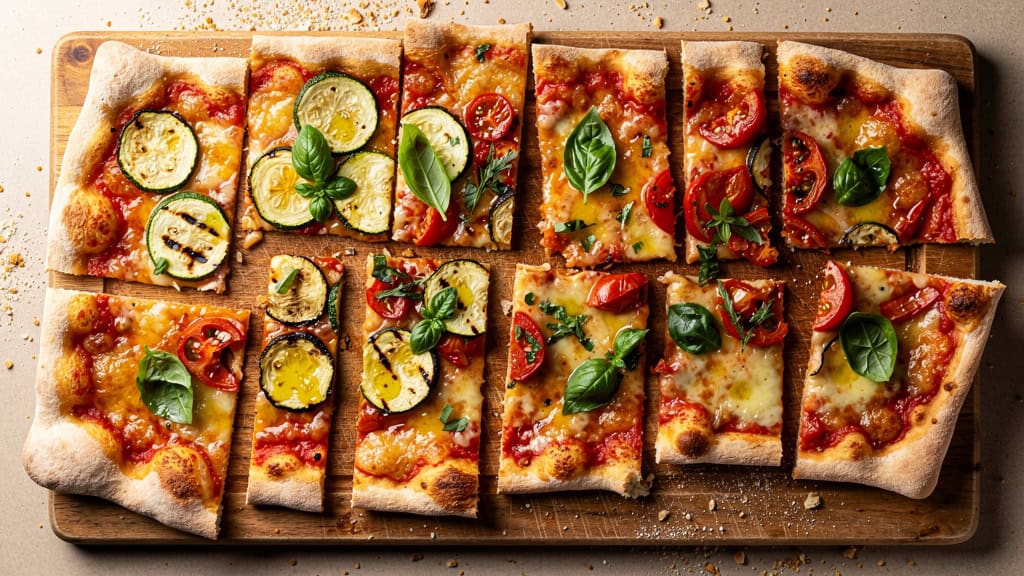
Just a short walk from Mordi e Vai, Casa Manco serves pizza al taglio that keeps winning new fans. The husband‑and‑wife team behind the counter give their dough nearly one hundred hours to rise, which creates a base that is airy, light, and crisp at the edges. On top of that canvas they layer seasonal ingredients, many bought from nearby stalls.
One day we may find zucchini blossoms and anchovies, another day spicy ’nduja with creamy cheese, or a rainbow of roasted vegetables. Every tray looks like a little painting, but the flavors stay rooted in simple, honest Roman baking. We like to ask what came in fresh that morning and follow their suggestion, because the best slices often never make it to a printed menu.
Trapizzino
Trapizzino brings a more modern twist to Testaccio Food Market, while still honoring Roman home cooking. The name refers to a triangular pocket of pizza‑like bread, baked until fluffy, then split and stuffed with warm stews. It feels a bit like a mix between a soft sandwich and a stuffed calzone, with fillings that would normally sit on a plate with a fork.
Popular choices include:
- Coda alla vaccinara, an oxtail stew cooked in tomato with celery
- Pollo alla cacciatora, chicken simmered with herbs, wine, and vegetables
For visitors who want to try these rich, traditional dishes without sitting down for a full meal, a Trapizzino is almost perfect. We can eat it with one hand while strolling the aisles, and still taste flavors nonne have cooked for generations.
Other Notable Street Food Stops
Beyond the famous names, many other counters call to us as we walk. Spiros Bistrot offers a relaxed mix of Mediterranean and Roman comfort dishes, from layered Greek moussaka to couscous loaded with vegetables and tender meat. Portions are generous, prices fair, and the staff keep a friendly, unhurried rhythm that suits a long lunch.
For dessert, Dess Art puts out trays of cakes, pastries, and sweets that pair well with a shot of espresso. Around the hall we can also find Sicilian‑style fried rice balls, Jewish‑style artichokes, Venezuelan arepas, and more. When our energy dips, the coffee specialists at Chicchi e Lettere in Box 43 grind and serve beans with real care. The range of flavors reflects modern Rome, full of influences, yet the mood stays proudly local. The best way to eat here is to graze, sharing bites from several stalls so nothing feels too heavy and every taste feels new.
Shopping For Ingredients: The Best Fresh Produce, Meats, And Artisan Goods
As tempting as the street food is, Testaccio Food Market is still, at its core, a place where Romans buy what they cook at home. This is where we see grandmothers checking tomatoes with expert fingers and fathers teaching kids how to choose the right fish. For travelers who rent an apartment or simply want a picnic, the ingredient stalls are a joy.
Top Produce Stalls
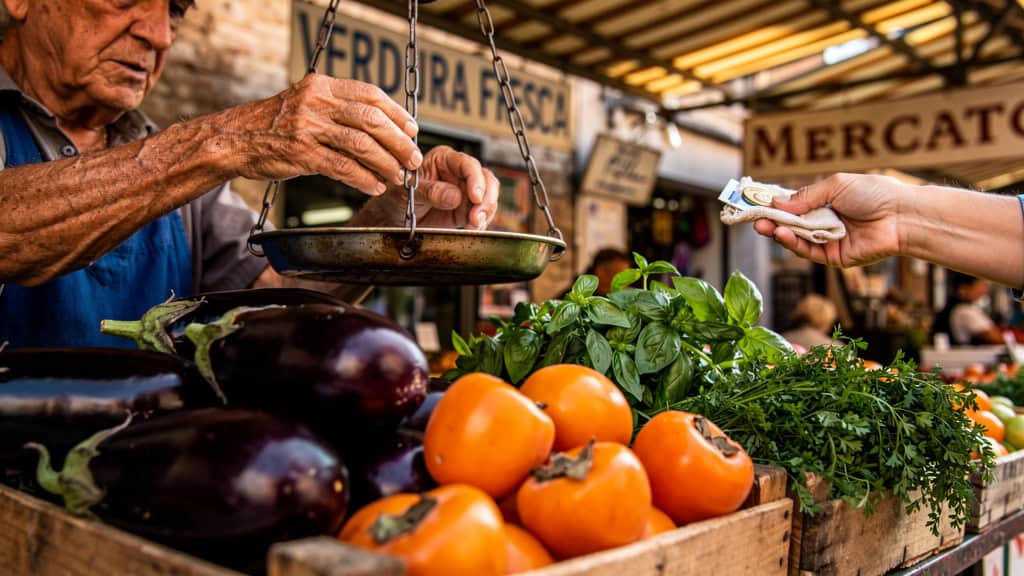
The heart of the produce section beats loudest at Silvia and Gabriele’s stand in Box 68. They belong to the Campagna Amica network, which means everything they sell comes directly from their own family farm or nearby trusted farms. That local focus makes their stall a small lesson in Italian seasons.
- In winter we find piles of knobbly romanesco broccoli and crates of shining clementines.
- In spring, artichokes line up by the dozens, next to tender peas and strawberries.
- Summer brings glossy tomatoes, peaches, and zucchini with their blossoms still attached.
Another excellent choice is Fior di Zucca in Box 82, whose name, meaning “zucchini flower,” shows how much they love that seasonal star. When we shop here, we often just point at what looks best and ask for enough for two people. Vendors happily pick the ripest pieces and will suggest how to cook them. Standing in line beside local nonne, listening to their recipes, feels like a free cooking class and a quiet act of support for small‑scale farming with low food miles.
Premium Meats And Specialty Items
For meat lovers, the Sartor family in Box 70 is a trusted name inside the market. They focus on organic meat and eggs, with cuts that suit slow Roman recipes as well as quick weeknight cooking. If we want to try making coda alla vaccinara at home, this is where we ask for oxtail. If we plan to grill, they guide us to the right sausage or steak.
Around them, other stalls sell wedges of aged pecorino romano, paper‑wrapped cured meats, jars of olives, and fragrant loaves of organic bread. With a bit of planning, it is easy to build the perfect picnic from these counters, adding fruit, cheese, salami, and a still‑warm loaf. Many locals still choose these family stalls over large supermarkets, not only for flavor, but for the trust built up over years of regular visits.
Artisan Baked Goods
No visit to Testaccio Food Market feels complete without a stop at Da Vania e Artenio in Box 90. This bakery stall is loved as much for the smiles behind the counter as for the trays of snacks. We often start with pizzette rosse, small rounds of crisp dough covered with simple tomato sauce and a hint of oregano. Onion‑topped pizzette bring a sweet, caramelized bite that pairs well with a cold drink.
For something to take home or nibble later, we pick up bags of taralli, crunchy savory rings perfect with wine, and ciambelline al vino, crumbly cookies also laced with wine. Children get greeted by name here, and regulars swap news while their bags are filled. Every bite feels like a taste of everyday Roman snacking culture, the kind of food people actually eat between meals, not just what appears in glossy magazines.
Insider Tips For Visiting Like A Local Roman
Even in a friendly place like Testaccio Food Market, a little inside knowledge makes the visit smoother and more fun. Over time, we have learned when to go, how to pay, what to say, and how to move with the local rhythm. These small details turn a simple walk through the aisles into a relaxed, confident experience.
Best Times To Visit And How Long To Stay
We usually recommend visiting on a weekday morning, roughly between nine and eleven. At that time, stalls are fully stocked, vendors are still fresh, and the lunch crush has not yet filled every seat. Mondays can be a bit quieter, with some stalls resting after the weekend, while Sunday afternoons often bring limited hours or closures.
Plan on at least one to two hours if possible. That gives time to stroll, taste a few things, and maybe circle back for seconds. Travelers with very tight schedules, such as cruise passengers who only have a short window in Rome, can still enjoy a forty‑five‑minute food crawl by heading straight to a few key stalls.
Payment Practicalities
Despite the modern feel of the building, Testaccio Food Market still runs largely on cash. Many larger stalls accept cards, but smaller produce vendors may not, and some prefer not to run very small card payments. We like to arrive with a mix of coins and small euro notes, since breaking large bills can be hard during busy times. Nearby cash machines offer a backup, but it is faster to arrive prepared. Prices are fair, with panini often between four and six euro and generous pizza slices around three to five.
Ordering Like A Local: Essential Italian Phrases
Trying a bit of Italian here goes a long way. This is still a working‑class neighborhood, and vendors respect visitors who make an effort. We start every interaction with a warm “Buongiorno” and a smile, which often gets a big smile in return.
A few handy phrases:
- “Buongiorno” – Good morning
- “Per favore” – Please
- “Vorrei…” – I would like…
- “Posso avere…?” – May I have…?
- “Mi consiglia qualcosa?” – What do you recommend?
- “Quanto costa?” – How much does it cost?
- “È possibile assaggiare?” – Is it possible to taste?
When we feel unsure, we ask “Mi consiglia qualcosa?” and let the vendor pick a favorite dish. The more relaxed and patient we are, the more likely vendors are to share stories, extra tastes, or quiet off‑menu specials.
Market Etiquette And Local Customs
Market life has its own gentle rules:
- Sampling is welcome, but it should never feel like a way to eat a full meal for free, so we always plan to buy from stands that offer generous tastes.
- Eating on the spot is completely normal, whether standing at a counter or sitting in the central seating area, and no one minds a bit of tomato sauce on fingers.
- Bringing a reusable shopping bag is both practical and kind to the environment, even though vendors offer their own bags.
- When we want to take photos of people or their stalls, we ask first with a smile and a quick “Foto, per favore?” to keep things respectful.
During busy periods, loose lines form, so we pay attention to who arrived before us and wait our turn. Curiosity and kindness are the keys here, and they nearly always lead to better food and better stories.
“When in Rome, do as the Romans do.” – Traditional proverb often linked to St. Ambrose
Beyond Food: Other Market Treasures Worth Discovering
Food may be the main reason we come to Testaccio Food Market, but it is not the only reason to stay. The market still functions as a full‑service neighborhood hub, the kind that once existed in every Roman district. Walking past the food aisles into the other sections reveals details of daily life that most visitors never see.
One of the most charming non‑food stalls is Cesare’s Shoes in Box 40. Here we find well‑made Italian footwear, often at prices far lower than fancy boutiques in the center. Cesare himself is something of a character, known for his love of fishing as much as for his shoes. The styles feel classic, built to last, and give a glimpse of local taste away from designer logos.
Scattered between the stalls we see flowers and plants, adding bright color to the hall. Locals buy simple bouquets for dinner tables or small potted herbs for kitchen windows. Vintage clothing racks hold everything from leather jackets to printed dresses, perfect for visitors who enjoy hunting for one‑of‑a‑kind pieces. Nearby, a small hairdresser’s corner quietly buzzes with clippers and neighborhood gossip while customers wait their turn.
There are also stands with household goods, cleaning supplies, and small tools. Seeing these makes it clear that this is not a market staged just for cameras. People come here to get haircuts, buy shoes, pick up dish soap, and grab dinner ingredients all in one trip. Taking a few minutes to wander beyond the food aisles helps us understand how closely the market is woven into everyday Roman routines.
The Market As Community Heart: More Than Just Shopping
Spending time at Testaccio Food Market feels a bit like watching a living family album. The building may be new, but the relationships inside are old and strong. For many residents, a daily or weekly stop here is less a task and more a social ritual.
We see this most clearly in the way vendors and customers greet each other. Butchers remember how thick one customer likes her steak and which sausage mix her children prefer. Bakers know whose kids love the onion pizzette and might tuck an extra small piece into the bag. At the coffee bar, regulars lean on the counter, sipping espresso while sharing the latest neighborhood news. These little touches give the hall the warmth of a shared living room.
The market also holds traces of past generations. Many stalls pass from parent to child, and sometimes even to grandchildren. It is common to see a teenager working beside a grandparent, learning how to weigh fruit, cut meat, or read a customer’s face. This passing down of skills helps hold on to recipes and habits that might otherwise fade in the age of big supermarkets and fast food.
By staying busy and adapting, the market has pushed back against the pull of anonymous shopping centers. It does so by offering something stores cannot match: real human connection along with products. Longtime dishes like quinto quarto stews sit comfortably beside newer ideas like Trapizzino. Seasonal shopping and nose‑to‑tail cooking fit naturally with modern ideas about less waste and more respectful meat use. For visitors, stepping into this world offers a rare look at how a Roman neighborhood still feeds both stomach and spirit. This sense of respect for local life is also what we care about at ETuk Tours Rome, and it is why we love bringing guests to areas that still live and breathe on their own terms.
Exploring Testaccio Neighborhood: Extending Your Market Visit
Testaccio Food Market makes a perfect anchor point for exploring the wider Testaccio quarter. The neighborhood sits just beyond Aventine Hill, only about a twenty‑minute walk from the Colosseum, yet it feels far from the souvenir stands and crowded piazzas. With a full belly and a bit of curiosity, we can easily turn a market visit into a rich half‑day in one of Rome’s most character‑filled districts.
Monte Testaccio: Monte Dei Cocci
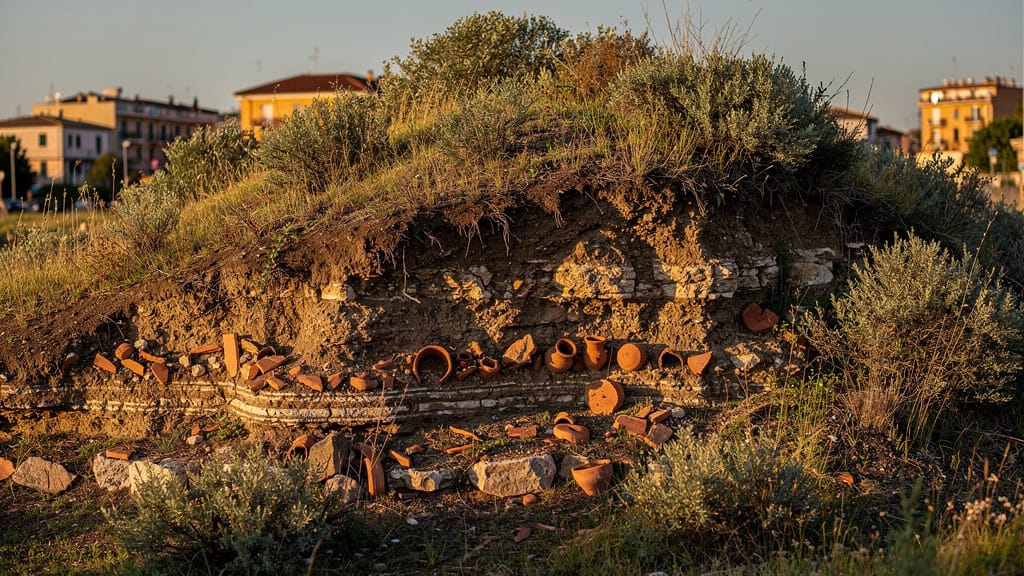
A short walk from the market brings us to Monte Testaccio, also called Monte dei Cocci. At first glance, it looks like an ordinary green hill with trees and old walls. In truth, it is made from layer upon layer of broken amphorae, the clay jars that once carried olive oil to Rome. Workers carefully stacked the shards so they would not slide, creating a kind of ancient recycling project that grew over centuries.
Walking around the base, we can still spot pieces of pottery in the walls, marked with old stamps. A slow fifteen‑ to twenty‑minute loop here, especially after a good lunch, helps us connect the oil trade of ancient times to the food culture that survives in Testaccio today.
Ex-Mattatoio: The Former Slaughterhouse Complex
Not far away stands the Ex Mattatoio, the former city slaughterhouse that shaped the neighborhood’s modern history. The large brick buildings and metal structures once held animals, workers, and the early forms of the dishes we now eat in panini and trattorie. Today, much of the complex has been turned into a museum and cultural space, with exhibitions and events that touch on art, design, and social history.
Visiting gives us a better feel for the working lives that created the quinto quarto tradition and the market’s strong character. Opening hours can shift with events, and some exhibits have a small admission fee, so it helps to check ahead, but even a simple walk around the courtyards adds depth to the food we just tasted.
Other Neighborhood Highlights
Testaccio also wears its love for football on its sleeve. The official fan club for AS Roma has deep roots here, and on match days the mood in local bars rises fast. Along the streets near the market, classic trattorie serve dishes made with ingredients often bought that same morning in the hall we just visited. Plates of amatriciana, cacio e pepe, and coda alla vaccinara feel especially meaningful after seeing the raw ingredients.
In the evening, the area shifts again as locals gather at wine bars and simple clubs. Compared with the center, the crowd here feels more truly Roman than tourist‑heavy, which makes a few hours of wandering even more rewarding. It is easy to fill three to four hours between the market, a walk around the hill, a peek at the Ex Mattatoio, and a slow drink at a corner bar.
How To Get There And Plan Your Visit
The Nuovo Mercato di Testaccio sits on Via Lorenzo Ghiberti, close to Via Galvani in the Testaccio neighborhood. From central Rome, the easiest route is usually Metro Line B to Piramide station, then a five‑minute walk, or a short ride on several bus lines that stop nearby.
The market generally opens Monday through Saturday from seven in the morning until around three‑thirty in the afternoon, though it is always wise to confirm current hours before setting out. For travelers with very limited time, including cruise passengers coming from Civitavecchia, an organized tour such as those offered by ETuk Tours Rome can remove the stress of planning routes and link a market visit with other key sights in one relaxed schedule.
Why Testaccio Market Should Top Your Rome Itinerary
With so much to see in Rome, it can be hard to decide what fits into a short stay. We strongly believe that Testaccio Food Market deserves a spot near the top of the list. While famous squares like Campo de’ Fiori draw many cameras, they also draw higher prices and a growing number of stalls aimed mainly at visitors. In Testaccio, locals still outnumber tourists, and the rhythm of real life guides the day.
What sets this market apart is the rare mix of serious street food and high‑quality ingredients under one roof. In a single visit, we can bite into a legendary tripe panino, buy vegetables from a farmer who grew them, and watch a baker pull slow‑risen pizza from the oven. We taste the quinto quarto tradition that grew out of hardship, we support farmers who sell directly, and we see how little waste is needed when every part of an animal or plant has a dish.
For travelers on the clock, this kind of experience saves time without feeling rushed. Spending one to two hours here teaches more about Roman food culture than many long meals scattered around town.
A quick summary of why the market is worth a place on any Rome itinerary:
- Real local atmosphere – shoppers with carts, kids after school, and workers on lunch break
- Top‑tier Roman street food – panini, pizza al taglio, Trapizzino, and more in one hall
- Fresh ingredients – farmers, butchers, and bakers selling what Romans cook at home
- Easy location – close to central sights yet away from the thickest crowds
A stop at Testaccio Food Market also balances the big stone stories of Rome. The Colosseum and Forum show power and empire. Testaccio shows frying pans, shopping bags, and shared tables. Together, they tell a fuller tale of the city. When we stand at a stall, listening to a vendor explain the right way to cook artichokes, we begin to understand why food means so much here and how those traditions have stayed strong for centuries. That feeling stays long after the last crumb is gone.
Conclusion
By the time we step back out onto the street from Testaccio Food Market, bags in hand and a bit of tomato on our shirt, it is clear that this is no ordinary stop. Here, working‑class history, ancient trade routes, and modern flavors all meet in one friendly, busy space. Slow‑cooked quinto quarto stews fill sandwiches, farmers lay out produce from just outside the city, bakers slide trays of pizzette from hot ovens, and neighbors swap news between sips of espresso.
This one hall offers a full picture of Roman food life. We can taste at Mordi e Vai, nibble on Casa Manco’s long‑raised pizza, snack on cookies from Da Vania e Artenio, and still have room to pick up fruit for later. Around us, the market hums with routines that have gone on, in one form or another, for generations. It feels open, yet still deeply rooted in its district.
For anyone who wants more than a checklist of monuments, Testaccio Food Market gives something lasting. It shows how Romans eat at home, how they shop, and how they protect their food customs while adapting to new ideas about waste and sustainability. The nearby hill of Monte Testaccio and the Ex Mattatoio museum add even more context, turning a simple snack into a history lesson.
We know time in Rome can be short, especially for cruise guests and visitors squeezing the city into a single day. That is why we often suggest putting this market high on the plan. For those who want help fitting Testaccio alongside the Colosseum, the Vatican, and other highlights, ETuk Tours Rome offers eco‑friendly, small‑scale tours that can include local food stops while gliding through narrow streets in comfort. However someone arrives, Testaccio is waiting, ready to share two thousand years of stories in every bite and every friendly “Buongiorno”.
FAQs
A few common questions come up again and again when we talk with guests about Testaccio Food Market. Here we answer them in one place so planning a visit feels simple instead of stressful.
What Are The Testaccio Market Hours And Best Time To Visit
The Nuovo Mercato di Testaccio usually opens from Monday to Saturday, roughly from seven in the morning until about three‑thirty in the afternoon. Hours can shift a little with seasons and holidays, so we like to double‑check before going. Mondays may feel quieter, and some stalls might open later or carry less stock.
The best window for most visitors is between nine and eleven on weekday mornings. At that time, counters look full, vendors have time to chat, and the lunch rush has not yet filled the aisles. Weekends bring more locals doing big weekly shops, which raises the energy but also the crowd level.
How Do I Get To Testaccio Market From Central Rome Or Civitavecchia Port
The market sits on Via Lorenzo Ghiberti in the Testaccio neighborhood, just a few minutes’ walk from the Piramide area. From central Rome, the simplest route is to take Metro Line B to Piramide station, then walk about five minutes following signs toward Testaccio. Several city buses also stop nearby, and it is about a twenty‑ to twenty‑five‑minute walk from the Colosseum or fifteen minutes from Circo Massimo.
Cruise passengers arriving at Civitavecchia can take a regional train to Roma Termini, which takes around sixty to seventy‑five minutes, then transfer to the metro or a taxi. Since the trip from the port to Testaccio and back can take more than ninety minutes each way, many cruise visitors find that a guided tour, such as those offered by ETuk Tours Rome, helps them see the market and other key sights without worrying about timing or transport.
Is Testaccio Market Worth Visiting Compared To Campo De Fiori
We hear this question often, and for us the answer is yes. Campo de’ Fiori is a beautiful square with a long tradition, but its market has shifted heavily toward visitors, with higher prices and many stalls selling spices, gifts, and dried blends that appeal more to cameras than to local cooks.
Testaccio, on the other hand, still serves mostly residents, with serious produce, meat, and fish, plus some of the best street food in the city. The atmosphere feels more relaxed and grounded, with fewer selfie sticks and more shopping carts. Travelers who care about real Roman food culture usually come away from Testaccio feeling far more satisfied.
What Should I Eat At Testaccio Market: What Are The Must-Try Foods
Starting with a panino from Mordi e Vai in Box 15 is almost a rule for us. The simmered beef with dandelion greens offers a rich yet gentle introduction, while the tripe sandwich gives a braver taste of quinto quarto cooking. Next, we like to share slices from Casa Manco in Box 22, choosing at least one vegetable‑topped pizza and one with something bold like ’nduja.
For adventurous eaters, a Trapizzino stuffed with oxtail stew brings deep flavor in a handy form. Baked goods from Da Vania e Artenio, such as pizzette rosse and taralli, make great snacks for later. Espresso from the coffee bar or Chicchi e Lettere rounds out the meal. Grazing on several small items instead of one big plate lets us try more dishes, and a full tasting often costs around ten to fifteen euro per person.
Do Vendors At Testaccio Market Speak English
English levels vary from stall to stall. At more famous food counters that see many visitors, someone behind the counter usually speaks at least some English. At smaller produce or meat stands, we sometimes find only a few words in common.
That said, pointing, smiling, and using simple Italian phrases work wonders. When we say “Buongiorno” and “Vorrei…” before pointing to what we want, communication flows easily. Vendors are generally patient and kind, and they appreciate the effort. Often, trying a bit of Italian leads to better service, extra suggestions, and sometimes a small free taste.
Is Testaccio Market Family-Friendly
Yes, Testaccio Food Market is a very good stop for families. The building is clean, open, and bright, with wide aisles that handle strollers and curious kids without stress. Children usually find plenty to eat, from simple pizza slices and plain panini to cookies and fruit. The central seating area offers a place to rest, regroup, and share snacks. Bathrooms are available, which always helps when traveling with little ones.
Vendors tend to be warm toward children, often smiling, joking, or adding a tiny extra treat to a bag. For parents who want to show their kids real Italian life without long museum lines, this market can be both tasty and educational.